
Mud Dauber Wasps in Colorado
Those pipe-organ mud tubes on your stucco aren't a paper wasp nest, and in most Colorado yards, they're not a threat either. Here's how to tell a mud dauber from a yellow jacket, and when the nest is actually worth removing.
How to identify a mud dauber
Colorado has several mud-nesting wasps, including the metallic blue mud dauber (Chalybion californicum) and the organ-pipe mud dauber. All share the same basics: skinny waist, mud nest, no colony.
Thread-thin waist
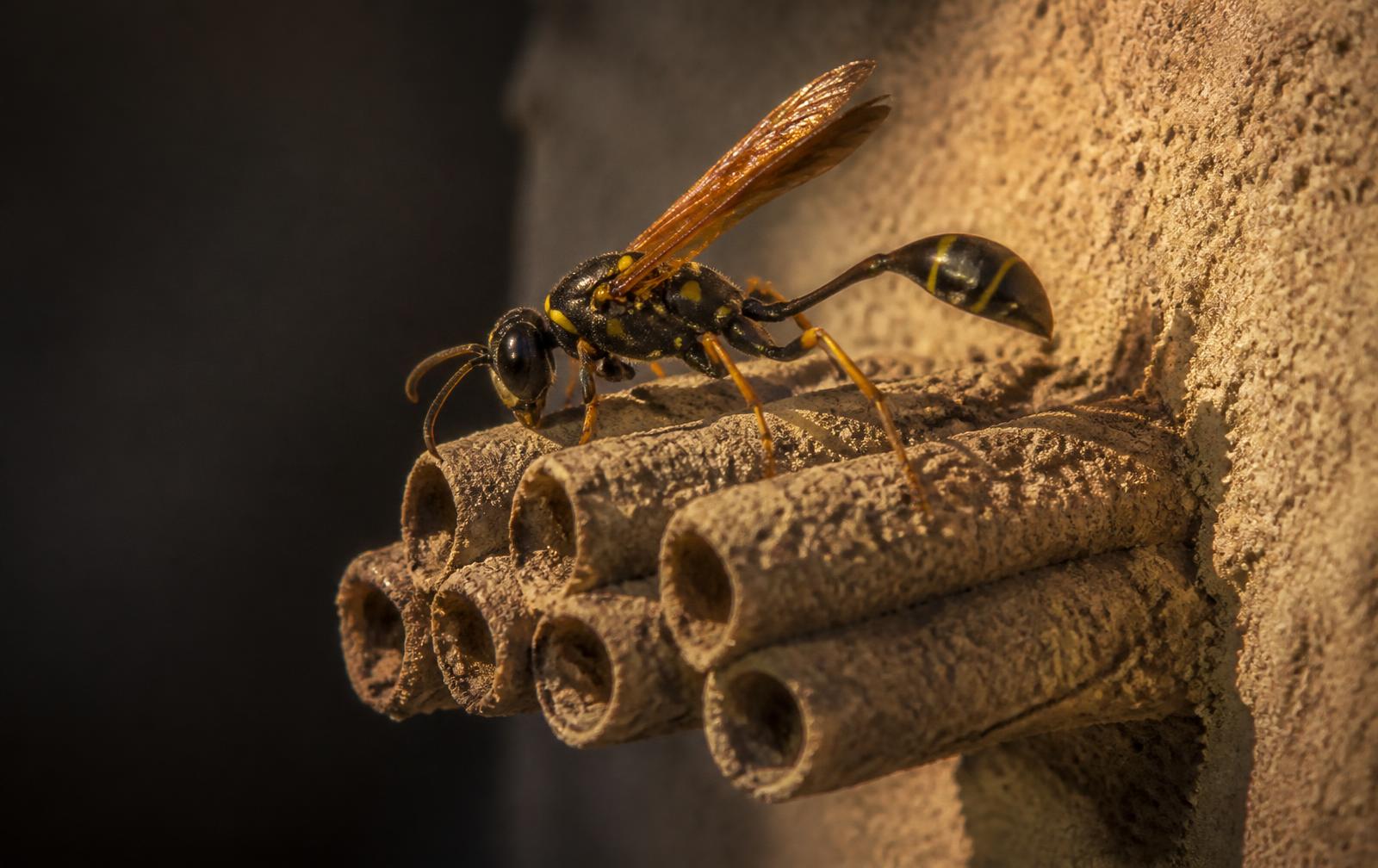
The giveaway. Black-and-yellow mud daubers (Sceliphron caementarium) have a long, wire-like petiole between thorax and abdomen, nothing like the compact, stocky build of a yellow jacket.
Dried-mud nest, not paper
Clay-colored tubes laid side by side like a tiny pipe organ, or a rough mud lump. Paper wasps and hornets build gray, papery cells from chewed wood fiber.
Solitary, not a colony
One female builds, provisions, and seals the nest alone. There are no workers to swarm, which is why mud daubers essentially never defend a nest the way yellow jackets do.
Quiet, slow fliers
You'll see them hovering low over damp soil collecting mud, or crawling on a wall. They don't scavenge trash, patio food, or sugary drinks. That's yellow jacket behavior.
Mud dauber vs. paper wasp vs. yellow jacket
The nest tells you more than the wasp does. Match what's on your wall:
Safety vs. threat: leave it or lose it?
Mud daubers are one of the few stinging insects we'll tell a Colorado homeowner to leave alone. Each mud cell is stocked with paralyzed spiders, often black widows, to feed a single larva, so a dauber working your garage is quietly reducing the spider population around it. They have no colony to protect and almost never sting.
The reason to remove a nest is usually the nest itself, not the wasp: hardened mud stains stucco and siding, abandoned tubes get colonized by other insects, and old nests draw new daubers back to the same wall year after year.
Remove the nest when…
- It's directly over a door, walkway, playset, or grill
- Someone in the household has a sting allergy
- Mud is staining stucco, brick, or painted siding
- Tubes are stacking up year after year on the same wall
- Old tubes are being reused by other wasps or spiders
- You genuinely can't tell whether it's a dauber or a yellow jacket
How OBEX handles mud dauber nests
Treat if active
If a female is still building or provisioning, we apply a targeted residual product to the nesting surface before anything is scraped.
Scrape and clean
Hardened tubes come off the wall, and the surface is cleaned so leftover mud and residue don't act as a rebuild template.
Preventative band
Exterior residual on eaves, soffits, garage frames, and shed walls, the sheltered surfaces daubers keep choosing.
We can't promise wasps won't come back. New females arrive every summer, and a wall that worked once will look good again. Preventative treatment reduces the likelihood of rebuilding; it isn't a guarantee. Pricing depends on nest height, surface, and how many nests are present, and it's confirmed on the phone before we schedule anything.
Mud daubers on the Front Range
Overwintered adults emerge and females begin collecting mud from ditch banks, irrigated lawns, and puddles.
Peak building. Colorado's dry heat cures mud fast, so tubes go up quickly on sun-warmed south and west walls.
Adults die off; larvae overwinter sealed inside the cells and emerge the next year, and a quiet nest may still be occupied.
If what you're seeing is aggressive, ground-nesting, or swarming a trash can, it isn't a mud dauber. Compare it against Colorado's paper wasps, yellow jackets, and bald-faced hornets.
Mud dauber FAQ
Are mud daubers dangerous in Colorado?
Rarely. Mud daubers are solitary wasps, so there is no colony to defend, so they almost never sting people. Most Colorado homeowners can leave an active mud nest alone. The exception is a nest over a doorway, on a playset, or somewhere a child or pet will bump it.
How do I know if a nest is a mud dauber nest?
Mud dauber nests are made of dried mud, not paper. Black-and-yellow mud daubers (Sceliphron caementarium) build side-by-side clay tubes that look like a small pipe organ or a lumpy mud smear. Paper wasps build an open gray umbrella of hexagonal cells, and bald-faced hornets build a large enclosed gray football. If it's dirt-colored and tube-shaped, it's a mud dauber.
Where do mud daubers nest around Colorado homes?
Sheltered, sun-warmed vertical surfaces: stucco and brick under eaves, garage ceilings and door tracks, sheds, barns, crawl space vents, patio covers, under decks, and behind shutters. They need a nearby mud source, so Front Range yards with irrigation, ditches, or bare soil see them most.
Do mud daubers reuse old nests?
The original wasp does not, but abandoned mud tubes are frequently taken over by other wasps and insects, and old nests attract new daubers to the same wall. That's why removing hardened, inactive tubes is worth doing even though the wasp is gone.
Do mud daubers keep spiders away?
To a degree. Mud daubers provision each mud cell with paralyzed spiders, black widows included, as food for their larvae. That makes them a genuinely beneficial wasp in Colorado, and one reason we recommend leaving out-of-the-way nests in place.
When are mud daubers active in Colorado?
Along the Front Range they appear in late May and June, build through the hottest part of summer, and finish by early fall. Larvae overwinter inside the mud cells and emerge as adults the following spring, so a nest can look dead in winter and still be occupied.
How do you remove mud dauber nests?
Hardened mud nests are scraped off and the surface cleaned so pheromone and mud residue don't invite rebuilding. If daubers are actively building, we treat the surface with a residual product first. Call (720) 613-5560 for a free quote. Pricing depends on height, surface, and how many nests are present.
Will mud daubers come back after removal?
They can. We never promise a wasp won't return. New females arrive every summer and a wall that worked once will look good again. Residual exterior treatments on eaves, soffits, and garage surfaces meaningfully reduce the odds of rebuilding.
Not sure what built that nest?
Send a photo or call, and we'll tell you whether it's a harmless mud dauber or something that needs treating. Free quotes across the Front Range, Denver to Fort Collins.